
The rise of generative AI, a technology capable of autonomously generating content, images, storyboards, videos and audio assets, based on the data it’s fed (typically we use a pre-trained LLMs (large language models), has recently emerged as a game-changer for these agencies. In this blog post, we share the key insights of out in-depth analysis on best practices and specialists’ interviews that describe what generative AI can and cannot do for this industry in the near term.
Dealing with the First Mover’s Dilemma
While traditional agency models focus on hours billed per function, moving into AI-driven automation presents potential challenges. It may seem daunting to be a pioneer in embracing automation (and hence reducing your billable hours only after you invested heavily in training, tools and new talents). This is especially difficult when there’s uncertainty about the clients’ acceptance of you reinvesting the saved costs into new innovative services that will improve the overall performance. However, making the switch poses a challenge to most agency leaders we interviewed. But stalling this transformation can spell doom. Generative AI isn’t just a fleeting trend—it’s shaping the future of marketing. Thus, agencies need a structured plan to integrate automation while experimenting with new AI-driven offerings. This is why we called it the First mover’s dilemma: You need to jump for sure and soon but you should also be able to convince your clients to trust a new offering and new approaches ot keep your budgets stable. So, how can you set out for new shores and minimize the risk of commercial failure in the short run?
Step-by-step approach towards a hybrid (AI-supported) agency model
The hybrid agency model means balancing automation with human genious and intuition and each marketing agency process, from planning to delivery, holds different potentials for automation. By categorizing the tasks in each process step into red, amber, and green, we can determine their automation capabilities and strategize accordingly:
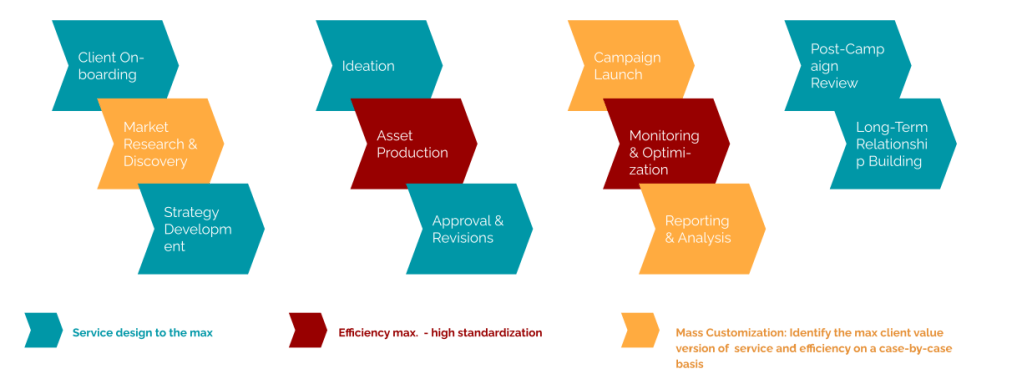
- Green (Human or Augmentation-focused Value Chain Steps): Focus on innovative service design and continuous improvement. These tasks, driven mainly by human expertise, are crucial for differentiating in the market. To ensure that specialists operate within budget constraints, lead with KPIs centered around account growth and positive team collaboration.
- Red (Highly Automatable Tasks): For these repetitive and generic tasks, the goal is maximum efficiency. Standardization is key. Junior staff, well-trained in AI tools, can handle these tasks early on, thereby freeing up the budget for more value-adding activities. Measure their success with efficiency and quality KPIs.
- Amber (Mass Customization Tasks with a certain automation but a high case-by-case tailoring by humans): These tasks are AI-supported but require senior staff for intense guidance across the process steps. There is not one process suits all and these thats are critical to client satisfaction why you don’t want to take risks in automation to early. The most familiar example is the content creation with AI: It needs a high skillset to understand how much human input at wich stage of the process is needed, which task are best executed by which LLM and which prompts work best in a sequence to achieve the required outcome of any given article.for tool selection and quality control. Consistent training, tool shortlists, and clear quality criteria are essential for those working on these tasks. Regularly scout for new tools to enhance automation as technology evolves is too. Guide this group using client satisfaction KPIs to help them strike the right balance between automation and human magic.
Starting step-by-step into an adapted business model
Generative AI is changing the landscape of creative marketing. It presents both challenges and opportunities. By understanding the nuances of each task and where automation can be beneficial, agencies can harness the best of both worlds—human creativity and AI efficiency. As the industry continues to evolve, it’s up to agencies to adapt, innovate, and lead the way in this new digital age and they are all aware that this experimentation phase needs to start better sooner than later.
By breaking down the transformation into manageable steps that can balance each others out, agencies can redefine their value chains for maximized user engagement, brand impact, and conversion rates of their clients’ campaigns with the help of AI and create new and innovative services that increase their clients’ value.
 Rottmann Lab